Aug 6, 2026Company News
Flat vs Twisted Paper Handles: A Data-Driven Selection Guide for Bag Manufacturers
Flat vs twisted paper handles: speed, strength, storage, equipment, and eco-adhesive tips. Data-driven guide for bag makers.
Choosing the right paper handle affects appearance, carrying comfort, production efficiency, material cost, and equipment investment. Both flat and twisted handles are recyclable and widely used in retail and takeaway packaging—but each serves different market segments.
1. Handle Types at a Glance
A flat paper handle is made from folded or laminated paper strips, with a smooth, wide profile attached to the bag via reinforced patches. It suits grocery, food delivery, bakery, and high-volume retail bags.
A twisted paper handle is made by twisting narrow paper webs into rope, then fixing, shaping, and attaching it to a paper patch. The rounded, textured profile gives a premium feel, making it ideal for fashion, gifts, cosmetics, and branded shopping bags.
2. Side-by-Side Performance Comparison
Dimension | Flat Handle | Twisted Handle |
Production speed | 160pairs/min | 100pairs/min |
Typical load capacity | 3-5kg | 5-8kg |
Carrying comfort | Wide pressure distribution | Rounded shape, easy grip |
Storage density | ~15–20% more units per pallet | Lower density due to rope bulk |
Customization | Paper color, width | Rope diameter, twist density, color, length, patch design |
Actual strength depends on adhesive quality, patch size, and paper grammage—not handle style alone. Always test with your materials.
3. Equipment & Investment Trade-Offs
Flat handle lines are simpler and more compact, achieving higher speeds with integrated making-and-pasting configurations. Twisted handle production involves a multi-stage process—rope making, rewinding, cutting, forming, and pasting—which requires more floor space and a higher initial capital investment. Importantly, switching from flat to twisted production is not a simple die change; it requires separate rope-making units or a dedicated line. For factories handling frequent small-batch orders, quick-change flexibility may outweigh maximum speed. For stable, high-volume contracts, dedicated high-speed lines deliver the best ROI.
4. Environmental Considerations
Both handle types are recyclable, but the finished bag's recyclability depends largely on the adhesive used. Water-based adhesives are preferred for repulping compatibility, while some hot-melt or solvent-based glues can contaminate the recycling stream. Brands targeting certified compostable or recyclable packaging must ensure that the handle adhesive, patch paper, and bag body paper are all compatible with the same pathway. Feiyang's pasting systems are designed to work with water-based adhesives, supporting sustainability goals without compromising bonding strength.
5. Which Handle Should You Choose?
Choose flat handles when your priorities are mass production efficiency, compact packing, practical appearance, and controlled cost—particularly suitable for food service, grocery, bakery, and everyday shopping bags.
Choose twisted handles when appearance, grip, customization, and premium brand presentation matter more—excellent for fashion, gifts, cosmetics, specialty retail, and branded shopping bags.
For many manufacturers, offering both types provides the flexibility to serve different market segments and respond to changing customer demands.
6. Next Steps
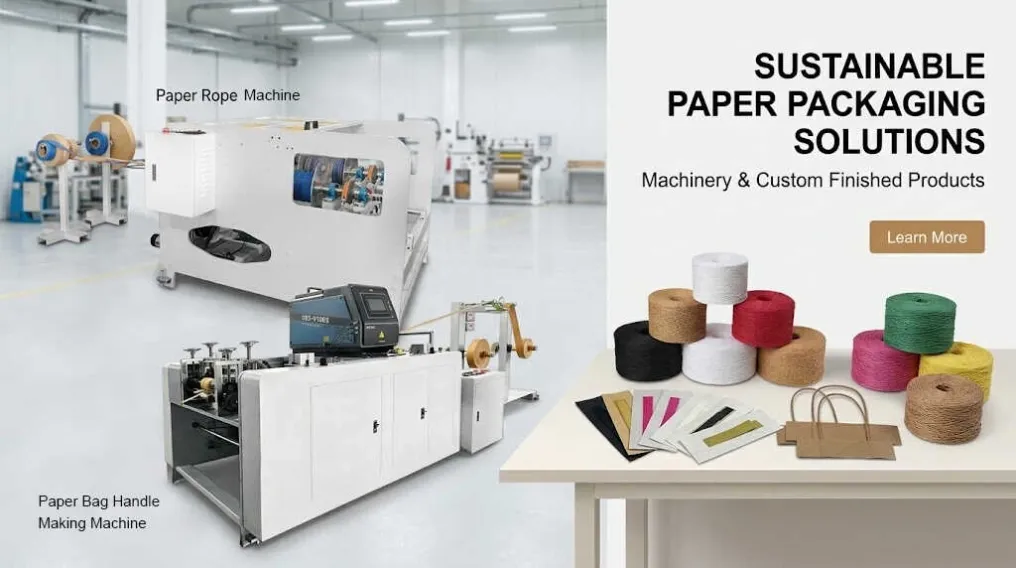
Dongguan Feiyang Packaging Machinery provides paper rope machines, flat- and twisted-handle-making equipment, and automatic pasting solutions.
We offer:
- Free load testing – Submit samples for strength verification
- On-site material trials – Run your paper stock on our machines
- Customized line recommendations – Based on your order mix, layout, and budget
Contact Feiyang for a detailed specification sheet including speed, power consumption, and footprint data per machine model.